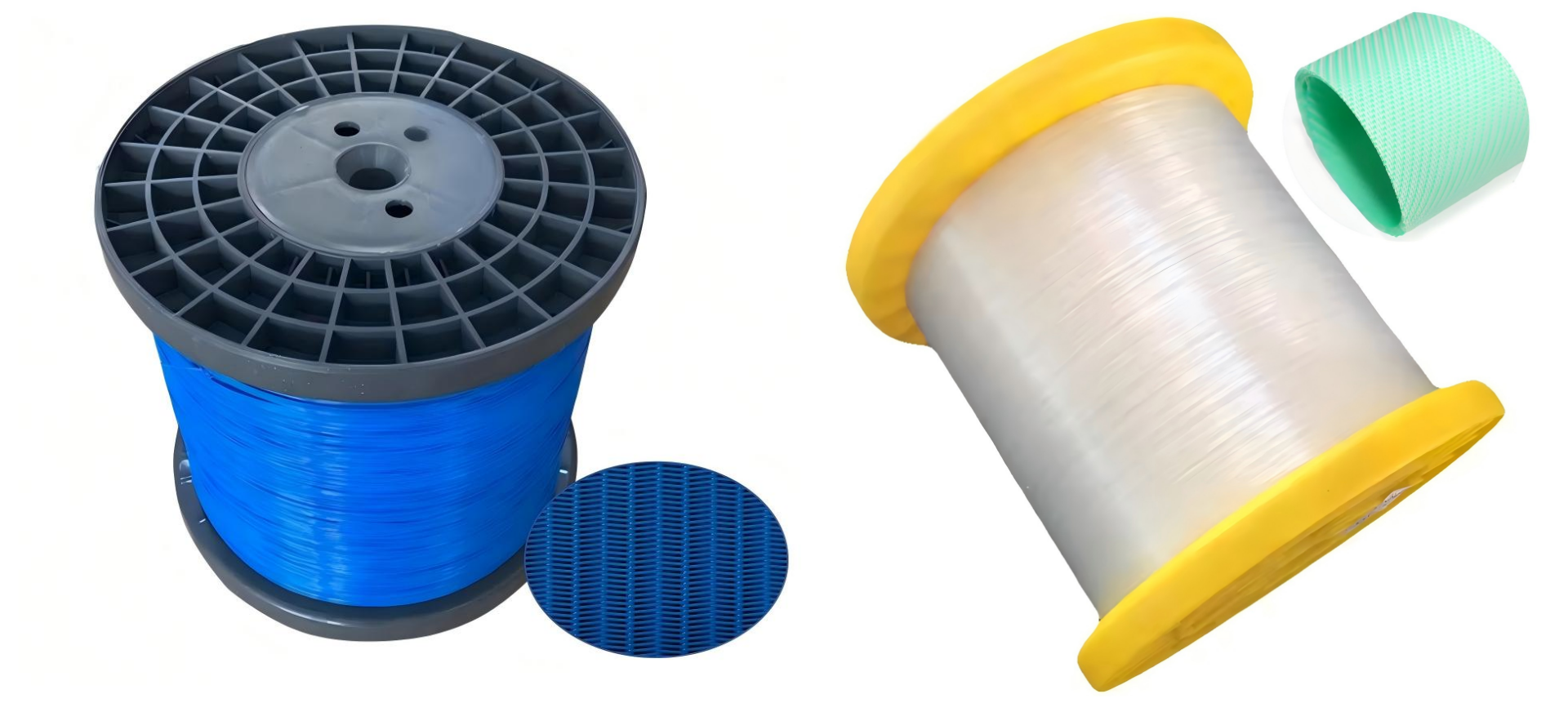
Selection of Materials for Dry Fabrics
Material Selection Principles
For low-speed paper machines, regular polyester monofilament or hydrolysis-resistant polyester monofilament can be adopted. Medium and high-speed paper machines widely utilize highly hydrolysis-resistant polyester monofilament. High-speed paper machines generally adopt PPS or PEEK monofilament for weaving. Under special working conditions, the entire dry fabric is manufactured completely with PPS and PEEK monofilament.
1 Polyester Monofilament
Polyester material is the first material applied to dry fabrics on a large scale, and it remains the most widely used material with diversified processing technologies to this day. Manufacturers keep optimizing processing techniques to improve the wear resistance and anti-aging performance of monofilament while retaining the inherent properties of polyester. Classified by molecular weight and elastic modulus, polyester monofilament is available in high, medium and low grades with a complete product range. Wear-resistant nylon powder can be added during production to boost wear resistance. Hydrolysis-resistant additives are also incorporated to slow down the aging of monofilament under high-temperature and high-humidity conditions.
2 PPS & PEEK Monofilament
Polyphenylene sulfide (PPS) monofilament boasts better high-temperature resistance, wear resistance and anti-aging performance compared with polyester monofilament. Nevertheless, it features insufficient stiffness and higher procurement cost. For this reason, PPS monofilament is rarely used for all warp yarns to produce woven dry fabrics and spiral fabrics. Normally, it is blended with polyester monofilament at a specific ratio.
Polyetheretherketone (PEEK) delivers outstanding comprehensive properties: excellent heat resistance (heat distortion temperature reaches 300℃ after fiber reinforcement); stable performance in steam at 200~260℃; top-tier fatigue resistance and creep resistance among thermoplastics; superior chemical resistance (resistant to most solvents except concentrated sulfuric acid and concentrated nitric acid). In addition, it possesses good radiation resistance, flame retardancy, mechanical strength and electrical insulation properties.
3 Nylon Monofilament
Nylon monofilament is seldom applied in dryer section dry fabrics. It offers excellent wear resistance and low deformation, yet its heat resistance is inferior to polyester monofilament. It can be selected for dry fabric production only for working conditions with moderate temperature, special requirements on wear resistance and strict cost control.
4 Special Functional Monofilament
According to customers’ special working condition requirements, monofilament with special functions can be partially or fully adopted for dry fabric weaving. For instance, dedicated anti-fouling monofilament will be applied when conventional anti-fouling polyester monofilament fails to meet stringent anti-staining requirements. Anti-static monofilament will be matched for scenarios requiring anti-static performance.
Our company supplies dry fabric monofilament raw materials of various materials, models and specifications. All customers are welcome to contact us for inquiries and discussions.